

ESF+ Social Services Hub 2026: SOLIDAR members meet in Athens to strengthen access to ESF+ for social services
Athens, Greece | 5–6 November 2026
How can social services organisations make better use of European Social Fund Plus (ESF+) funding? What barriers prevent them from accessing available opportunities, and how can cooperation with Managing Authorities be strengthened?
These questions are at the heart of the ESF+ Social Services Hub, a joint initiative developed by SOLIDAR, Caritas Europa, the European Social Network and Eurodiaconia to strengthen the capacity of social service providers to access, use and engage with ESF+ funding.
Running from 2026 to 2029, the Hub forms part of the organisations’ work supported through the Employment and Social Innovation (EaSI) strand of ESF+. It combines peer learning, practical guidance, policy dialogue and capacity-building activities, including annual webinars on access to ESF+ funding and an annual meeting bringing together social service providers, civil society organisations, Managing Authorities and other relevant stakeholders.
As part of this work, the ESF+ Social Service Hub 2026 Annual Meeting and Peer Learning Event, took place on 5–6 November in Athens. The event, organised by the partners of the initiative, was co-hosted with the University of West Attica – Social Administration Research Lab (SARL UNIWA).
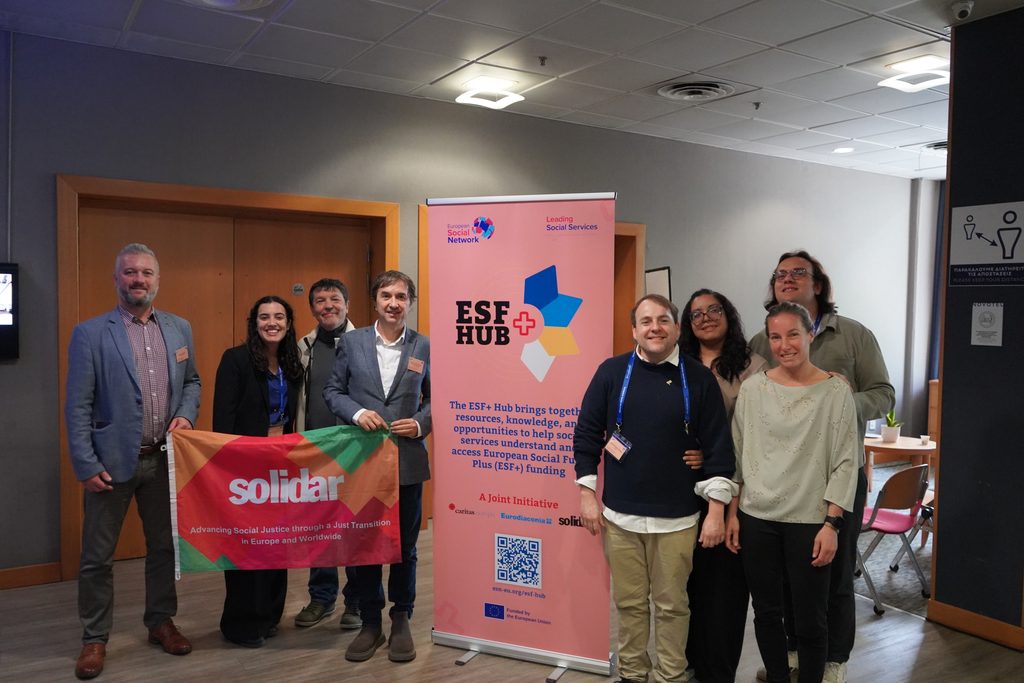
SOLIDAR participated with a strong delegation of member organisations from across Europe, bringing different national perspectives on access to ESF+ and on the role of social service providers in its implementation. The delegation included representatives from Samaritan International (Belgium/Germany), Povod Institute (Slovenia), Movimiento por la Paz, and Liga Española de la Educación y la Cultura Popular and Prodiversa (Spain) La Ligue de l’Enseignement (France) and Initiative for Development and Cooperation (Serbia).
Their participation also reflects SOLIDAR’s broader work under its BRIDGE programme 2026–2029, this work combines capacity building, peer learning, practical guidance on ESF+ access, exchanges with Managing Authorities and evidence-based advocacy.
Understanding the challenges of accessing ESF+ funding
The meeting opened with contributions from Gabriel Amitsis, Professor of Social Security Law and Director of SARL UNIWA; Ioannis Livanos, President of the Regional Social Welfare Centre of Attica; and Olga Verikaki, General Secretary of the Hellenic Association of Social Workers. Verikaki highlighted the essential role of ESF+ in strengthening social services, warning that proposed changes to the EU budget architecture for 2028–2034 could reduce their visibility and put existing support at risk. She concluded with a reminder of the value of social investment: “Investment in social services should never be seen as a cost to society, but as an investment in its future.”
The opening session featured also Alfonso Lara-Montero, CEO of the European Social Network (ESN), and Michiel Berrevoets, Policy Officer at the European Commission’s Directorate-General for Employment, Social Affairs and Inclusion (DG EMPL). Berrevoets presented the Commission’s perspective on ESF+ and its contribution to the European Pillar of Social Rights, highlighting three interconnected areas: social inclusion, employment, and education and skills.
Looking ahead: ESF+ and the next EU programming period
A key part of the discussion focused on the proposed EU funding architecture for 2028–2034. The Commission’s proposal introduces National and Regional Partnership Plans (NRPPs), aiming to bring different funding instruments into a more integrated framework. Each Member State would have one overarching plan, potentially including regional and sectoral chapters and a dedicated social chapter. ESF would retain its standalone sectoral regulation while becoming part of this broader framework.
Berrevoets explained that the European Semester, including Country Reports and Country-Specific Recommendations, would help guide investment priorities. He encouraged social services organisations to prepare early by identifying relevant funding programmes, building partnerships with Managing Authorities and public authorities, demonstrating the impact of their work and anticipating implementation requirements. With negotiations still ongoing, early engagement and evidence-based advocacy will be essential to keeping social priorities visible in the next EU budget.
Participants also exchanged experiences from the Netherlands, the Basque Country, Romania, Italy, Sweden and Greece, exploring how ESF+ translates into support for communities. Practical case studies showcased the FAVO project in Gothenburg, the development of a new child protection system in Greece and the South Aegean Social Inclusion Observatory.
Strengthening cooperation between Managing Authorities and social services
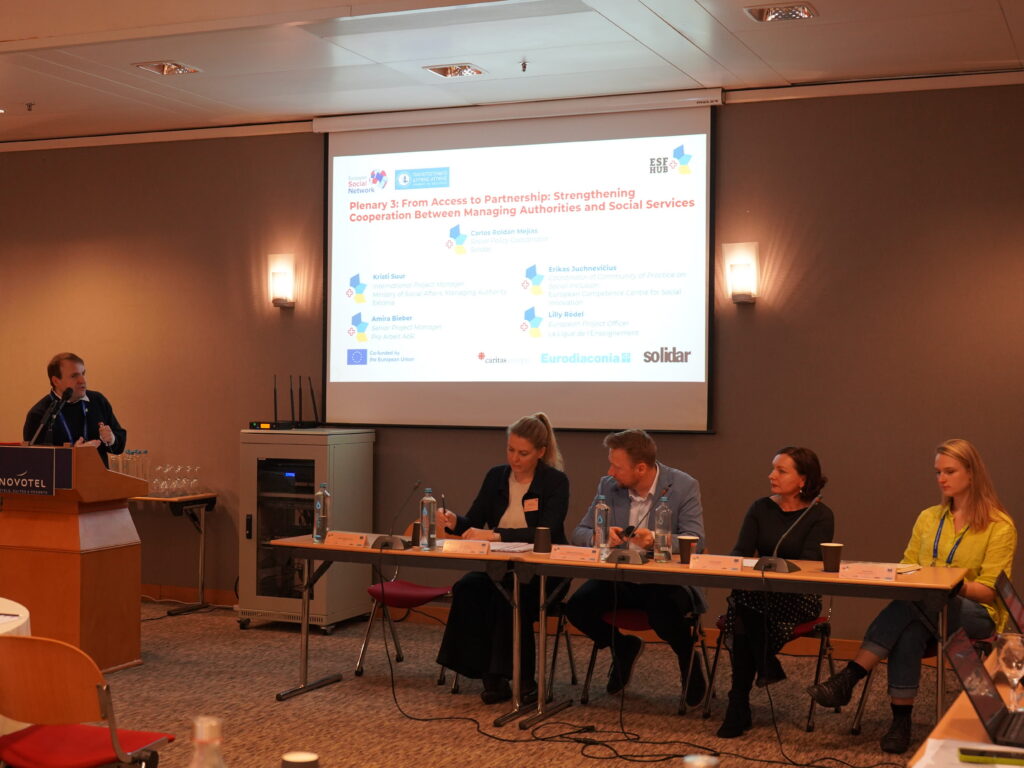
On 6 November, Carlos Roldán Mejías, Social Policy Coordinator at SOLIDAR, moderated a plenary session on strengthening cooperation between Managing Authorities and social services, bringing together perspectives from civil society and public authorities.
Lilly Rödel representing SOLIDAR member La Ligue de l’Enseignement, France, highlighted the difficulties smaller organisations face in accessing ESF+, including complex procedures, pre-financing requirements and limited staff capacity. Drawing on national-level work carried out with SOLIDAR, she called for stronger partnerships, peer learning and clearer information.
Amira Bieber (Pro Arbeit AöR) emphasised the importance of dialogue between funding authorities and organisations working directly with beneficiaries, while Kristi Suur (Estonian Ministry of Social Affairs) stressed the need for hands-on support and more accessible funding opportunities, particularly for smaller organisations.
Finally, Erikas Juchnevičius (European Competence Centre for Social Innovation) underlined that cooperation must continue throughout the funding cycle. He highlighted the need for flexible funding, capacity building and early sustainability planning, particularly for projects supporting people in vulnerable situations.
The discussion reinforced a shared message: making ESF+ accessible is not only about simplifying procedures, but also about building lasting partnerships between Managing Authorities and the organisations delivering services on the ground.
From shared challenges to practical recommendations
The closing plenary brought together the main findings from the group discussions, with participants exchanging recommendations with representatives of the European Commission and Managing Authorities.
The recommendations reflected not only institutional perspectives, but also the practical experience of social service providers and civil society organisations, including SOLIDAR members participating in the meeting.
Participants highlighted five priorities:
- Make information on funding opportunities clearer and easier to navigate.
- Involve social services providers and civil society organisations earlier in programme design.
- Strengthen communication and partnerships between Managing Authorities and service providers throughout the funding cycle.
- Address administrative barriers that disproportionately affect smaller organisations.
- Support long-term planning and the sustainability of projects beyond individual funding periods.
The meeting also reaffirmed the role of the ESF+ Social Services Hub as a platform for peer learning, exchange and dialogue between stakeholders working to strengthen social services across Europe.
Making European funding work for social services
The Annual Meeting demonstrated the importance of bringing together European, national, regional and local perspectives to understand how EU funding works in practice.
For social services to fully benefit from ESF+, funding opportunities must be accessible, procedures manageable and cooperation with public authorities strengthened. Organisations working directly with communities must have a meaningful role in funding processes to ensure that European resources respond to social needs.
Through dialogue, the exchange of practical experiences and the development of common recommendations, the ESF+ Social Services Hub continues to help bridge the gap between European funding instruments and the social services supporting people and communities across Europe.
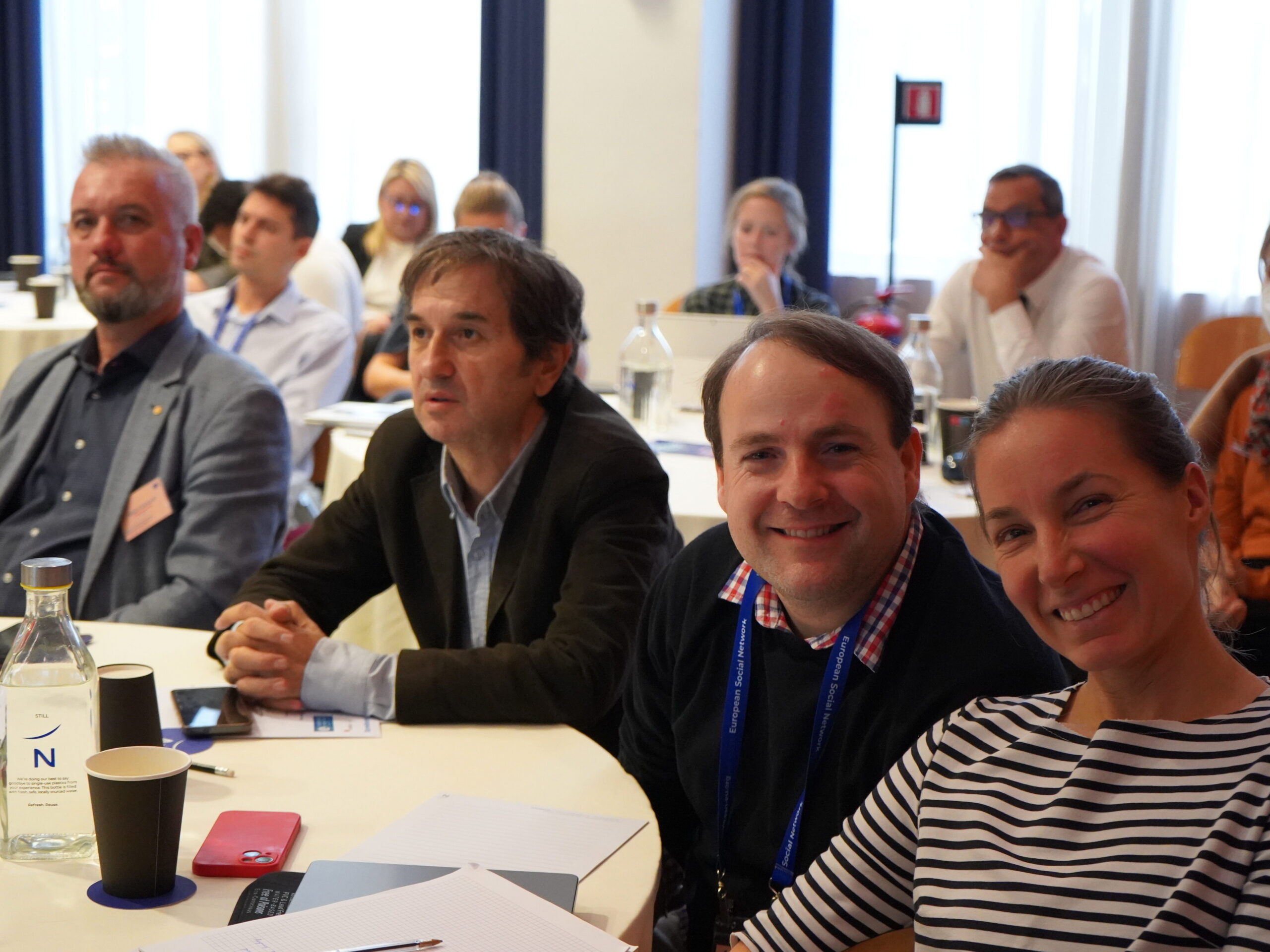
For SOLIDAR and its members, the Athens meeting was one step within the broader ESF+ Social Services Hub 2026–2029. The work will continue through annual webinars, peer-learning and capacity-building activities, exchanges with Managing Authorities and European-level advocacy aimed at making ESF+ more accessible, responsive and sustainable for social service providers.