

The Social Climate Fund launches, but will it support the most vulnerable?
On 5 March 2026, the European Commission’s Directorate-General for Employment, Social Affairs and Inclusion held a conference in Brussels to mark the launch of the Social Climate Fund, a fund designed to support vulnerable households and micro-enterprises in coping with the social impacts of the EU’s green transition.
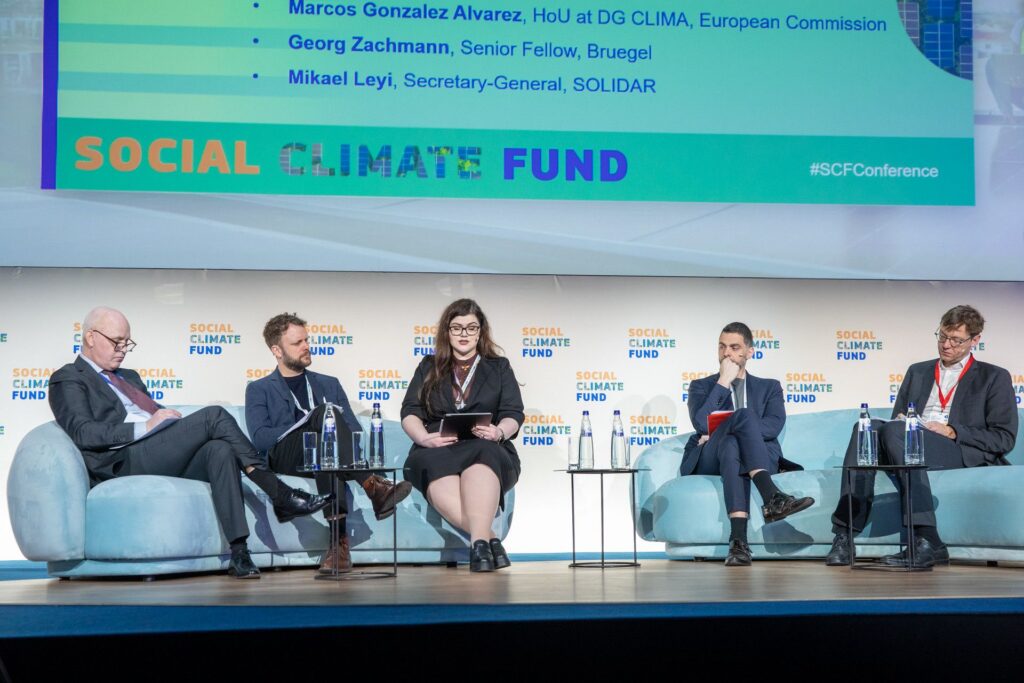
SOLIDAR was invited to speak at the first panel discussion of the event, where our Secretary General, Mikael Leyi, emphasised the importance of pursuing ambitious climate action alongside robust social policies, and the vital role of civil society in shaping the development and implementation of the Fund.
The major social effects of ETS2
As part of the 2021 Fit for 55 package under the European Green Deal, the EU expanded its EU Emissions Trading System (ETS) to include buildings and road transport, creating what is commonly referred to as ETS2. The ETS is a carbon market based on the ‘polluter pays’ principle, and it originally covered sectors such as industry, energy, aviation and maritime transport. The extension to buildings and road transport is a crucial step for decarbonisation, as these sectors represent a significant share of EU emissions: road transport accounts for around 20% of total EU greenhouse gas emissions, while buildings are responsible for around 12%.
However, while ETS2 is crucial for reducing emissions, it also has significant social implications. By putting a price on carbon in heating and transport fuels, the system is expected to push up energy and mobility costs by an average of 20%. Without adequate safeguards, these costs will disproportionately affect low-income households, many of whom already struggle to afford basic energy needs. In 2022, around 41 million Europeans were unable to adequately heat their homes.
In 2023, the EU established the Social Climate Fund (SCF) to mitigate these impacts. The SCF aims to provide both temporary income support and structural investments, such as building renovation and clean mobility solutions, targeted at vulnerable households and micro-enterprises. Overall, the SCF is expected to mobilise €86.7 billion, financed through revenues from ETS2 and redistributed through a progressive allocation formula that takes into account income levels and poverty rates across Member States. In absolute terms, the greatest beneficiaries of SCF funding will be Poland (17.60%), France (11.19%), Italy (10.81%), Spain (10.52%), and Romania (9.25%). To access the funding, governments must submit National Social Climate Plans for approval by the European Commission. These plans should outline concrete investment strategies and targeted support measures for the most vulnerable groups.
Concerns about the implementation of the SCF
Although the SCF is scheduled to start this year, several challenges threaten its timely and effective implementation. First, Member States were required to submit their National Social Climate Plans by 30 June 2025, but progress has been very slow. To date, only Sweden’s plan has been approved, while plans from Latvia, Lithuania, Malta and the Netherlands are under assessment. Many other countries have yet to submit their proposals.
Second, political pressure has led to delays in implementing the mechanism. In October 2025, Poland, the Czech Republic, Slovakia, Cyprus and Hungary sent a joint letter to the European Commission calling for the launch of ETS2 to be delayed until 2030. In November 2025, the Council of the European Union and the European Parliament reached an agreement on amendments to the European Climate Law, including postponing the launch of ETS2 by one year to 2028.
Nevertheless, some positive developments have emerged. In February 2026, the European Investment Bank approved a €3 billion ETS2 Frontloading Facility to allow Member States that have already transposed ETS2 into national legislation to pre-finance decarbonisation investments in buildings and road transport before ETS2 becomes operational in 2028. The frontloaded funding will primarily support investments in cleaner heating and cooling systems in homes and buildings across the EU and will benefit low- and middle-income households, in line with the objectives of the SCF.
SOLIDAR’s perspective: an underfunded response to a structural challenge
SOLIDAR stresses that the SCF is not just an additional policy measure, but a necessary mechanism to prevent rising inequalities and ensure vulnerable households can access well-insulated, energy-efficient homes that are healthier, more comfortable and cheaper to heat and cool, as well as efficient and affordable mobility options. In a context of growing inequality, resistance to climate policies, and the rise of populist and Eurosceptic movements, a just clean transition that protects the most vulnerable is both a political and social imperative.
However, the current size and scope of the SCF are insufficient to mitigate the social impacts of ETS2, and additional funding is required to address energy and transport poverty across Europe. SOLIDAR calls for 100% of ETS2 revenues to be mobilised for socially targeted measures prioritising vulnerable households, and urges Member States to strengthen their National Social Climate Plans using additional financial sources, including redirected fossil fuel subsidies, tax reforms such as removing VAT on electricity and reinforcing the polluter-pays principle, the Modernisation Fund, and, where relevant, ETS1 revenues.
Moreover, SOLIDAR urges those Member States that have not yet submitted their National Social Climate Plans to do so without delay. Plans must be robust, well-targeted and socially grounded to effectively protect vulnerable households, with a clear and complete exclusion of fossil fuel investments. Civil society organisations and local stakeholders must be meaningfully involved at every stage of the planning and implementation process, including through institutionalised National Social Climate Fund dialogues, and full transparency must be ensured throughout the process.
Lastly, we are concerned about the future. In the Commission’s proposal for the next MFF, spending from the Social Climate Fund in the National and Regional Partnership Plans is framed with weaker language on targeting and eligible investments and lacks an explicit focus on vulnerable households, creating a risk that those in energy poverty will not be properly prioritised. Funding must be fully aligned with the SCF Regulation, including eligible activities, end beneficiaries, and a clear focus on supporting vulnerable households.