
Policy Dialogue Slovenia – Social righs are both an EU and A national matter
On 14 April, SOLIDAR and our Slovenian member Povod organised a Policy Dialogue titled “The state of social rights in Slovenia – a European matter” in Ljubljana. The event is the first of a series of national events organised in the framework of the multi-annual programme “BRIDGE”, funded by the EaSI strand of ESF+.
The objective of the Policy Dialogues is to present the findings of our Social Rights Monitor to national stakeholders, sharing recommendations, calls to action and evidence to progress towards a more ambitious implementation of the European Pillar of Social Rights across Europe.
The event opened with a presentation of the Social Rights Monitor European Trends by Martina Corti (SOLIDAR). Her introduction provided a broader European perspective, highlighting common patterns across countries, including rising inequalities, pressures on social protection systems, and persistent gaps in access to rights – particularly for migrants and other vulnerable groups. This overview set the stage for the more detailed discussion on Slovenia.
Keynote speeches
In the keynote session, Matjaž Nemec (MEP, S&D) and Patryk Malesa (European Commission, DG EMPL) stressed that while the European Pillar of Social Rights provides a solid framework, its success depends on political commitment and concrete implementation.
Matjaž Nemec stressed how social policies in Slovenia cannot exist without EU social policies. He encouraged the introduction of legally binding measures in the domain of social policies at EU level and identified the need for structural funding. He finally raised the issue of social rights being under pressure in moments of crisis.
Patryk Malesa highlighted that Slovenia performs well in employment, already surpassing the EU’s 2030 target. However, challenges remain, including labour shortages, skills gaps, and low participation in adult learning. He also pointed to growing concerns around housing affordability, ageing, and access to long-term care.
Panel discussion: the state of social rights in Slovenia
Robert Križanič (Institute Povod), opened the panel discussion by presenting the key SRM findings for Slovenia. While the country compares favourably in several areas, structural issues persist:
- Rising housing costs and limited social housing
- Gaps in healthcare access and long-term care
- Labour market challenges, especially for migrants
- Barriers faced by civil society organisations
Despite an overall open civic space, CSOs still struggle with funding and limited influence on policymaking.
Štefan Simončič (Association EPEKA) focused on the housing crisis, advocating for housing cooperatives as an inclusive and sustainable solution, while noting the lack of legal frameworks, funding mechanisms and public awareness to support their development in Slovenia.
Samar Zughool (Reka Si Institute) highlighted the situation of migrant and refugee women, stressing that formal rights do not guarantee real access and pointing to gaps in integration policies, gender-sensitive approaches and legal frameworks affecting vulnerable groups.
Martina Trbanc (Social Protection Institute of Slovenia) provided an overview of social trends, noting that while Slovenia performs relatively well overall, important challenges persist. She pointed in particular to difficulties in accessing healthcare and long-term care, growing housing exclusion, and the increasing vulnerability of groups such as migrants, tenants and people at risk of poverty.
Shared Challenges Across Europe
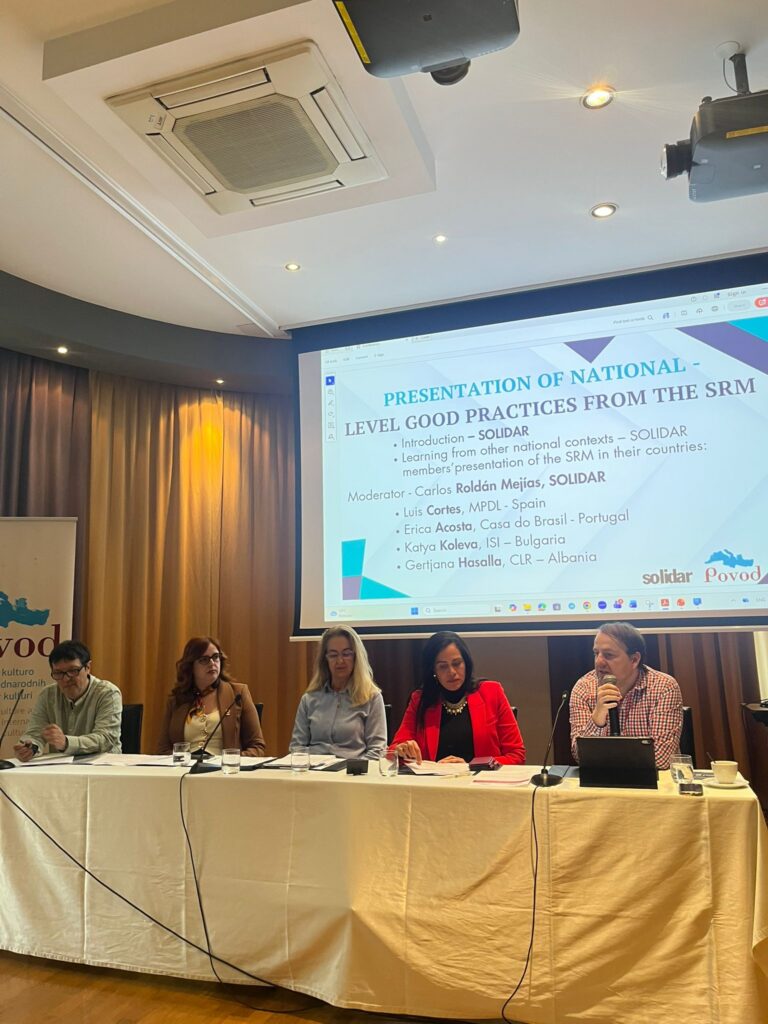
The afternoon session, moderated by Carlos Roldán Mejías (SOLIDAR), expanded the discussion to other national contexts. SOLIDAR’s members who participated in the SRM intervened to present the findings for their countries: Luis Cortes (MPDL – Spain), Erica Acosta (Casa do Brasil – Portugal), Katya Koleva (Institute for Social Integration – Bulgaria) and Gertjana Hasalla (Center for Labour Rights – Albania).
Common themes emerged:
- Persistent inequalities affecting migrants, especially women
- Housing crises and rising living costs
- Weak or shrinking civic space in some countries
- Labour market segmentation and in-work poverty
Speakers also shared good practices, such as migrant regularisation efforts in Spain, grassroots mobilisation in Portugal, STEM education initiatives in Bulgaria, and health mediation programmes in Albania.
The Social Rights Monitor assesses the state of social rights in Europe from the perspective of CSOs, which is a crucial function in moment when social rights are being de-prioritised from the EU and national agendas. SOLIDAR will continue disseminating its findings and using its evidence to support its advocacy work. The SRM 2026 edition is currently under preparation.