

Public presentation of the paper “Fair working conditions in Europe: Closing the gap for all migrant workers”
This month, SOLIDAR had the pleasure of hosting a conference on migrant workers’ rights and the European Pillar of Social Rights, bringing together civil society organisations, trade unions, and researchers to reflect on how persistent gaps in social and labour protection for migrants undermine individual rights, labour market fairness, social cohesion, and democracy in Europe.
The event took place on 3 December at Mundo Matonge in Brussels, in the framework of SOLIDAR DAYS 2025, and marked the culmination of six months of work dedicated to the development of an expert research paper.
The conference was opened by Martina Corti, Social Affairs Policy Officer at SOLIDAR, with a reflection on how the European Pillar of Social Rights has strengthened the EU social framework, while migrants’ rights, particularly in their role as workers, remain insufficiently recognised and insufficiently addressed in practice.
This Contribution was followed by a Keynote speech from Mikael Leyi, SOLIDAR Secretary General, placing the discussion within the broader challenges facing the European Social Model. He stressed that growing inequalities, social and political polarisation, and declining trust in democratic institutions threaten the foundations of the European Union. In this context, he warned against prioritising competitiveness and security at the expense of social justice and called for a renewed commitment to solidarity, equality, and dignity for all.
Mikael recalled that while the first Action Plan of the European Pillar of Social Rights marked an important milestone, its implementation has been uneven. Many of the Pillar’s principles remain aspirational, especially for people facing multiple and intersectional forms of discrimination. He pointed to persistent disparities affecting third country nationals, including higher risks of poverty and social exclusion, over representation in temporary and precarious employment, and high levels of over qualification. For undocumented migrants, policy attention remains largely focused on returns rather than on ensuring fair living and working conditions.
These dynamics, he argued, reveal a systemic failure to integrate migrant workers into Europe’s social model. Migrant workers are often trapped between insecure employment conditions and fear of deportation, which prevents them from reporting abuses or accessing justice. This situation fuels impunity and weakens labour standards for all workers, regardless of migratory status. Looking ahead, Mikael underlined that the forthcoming revision of the EPSR Action Plan is a crucial opportunity to address these shortcomings, provided it is backed by adequate financial resources and embedded in a broader, integrated social policy framework.
The presentation of SOLIDAR’s expert paper followed, delivered by its authors, Dr Amy Weatherburn and Marco Paron Trivellato. Dr. Weatherburn introduced the research by outlining its focus on migrant workers’ rights and their interrelation with broader migrants’ rights, as well as the essential contribution migrant workers make to the EU labour market. She thanked SOLIDAR members for their engagement, the organisations and individuals who contributed through surveys and interviews, and the peer reviewers involved in the process.
The research highlights the lack of explicit recognition of migrant workers within the European Pillar of Social Rights, alongside migration related vulnerabilities and forms of regulated precarity. It emphasises that the integration and inclusion of migrant workers are essential to building a successful Social Europe. Based on existing literature and links to the EPSR Action Plan, the study identified ten EPSR principles of particular relevance to migrant workers.
A central analytical framework of the paper is the cycle of rights protection and justice gaps. While rights formally exist, legal, administrative, and socio cultural barriers often prevent migrant workers from accessing them. Weak enforcement, limited monitoring, and lack of trust in public authorities reinforce this cycle. Concrete examples discussed included EPSR Principle 5 on secure and adaptable employment, where the absence of effective firewalls between labour and migration authorities discourages workers from lodging complaints. The paper calls on Member States to establish such firewalls, strengthen labour inspectorates, and on the EU to provide clearer guidance on implementation.
Further recommendations addressed EPSR Principle 7, stressing the need to improve access to information and awareness of rights, and EPSR Principle 8, highlighting the importance of strengthening trade unions and promoting structured cooperation with civil society organisations. Under EPSR Principle 12, the paper calls for procedural safeguards for all workers regardless of migration status and for administrative stability during judicial and non judicial proceedings.
Marco Paron Trivellato then facilitated an interactive session with participants, which explored priorities, challenges, and possible solutions to close the identified gaps. The discussion confirmed the importance of effective enforcement, access to justice, and cooperation among institutions, trade unions, and civil society actors, alongside legislative measures.
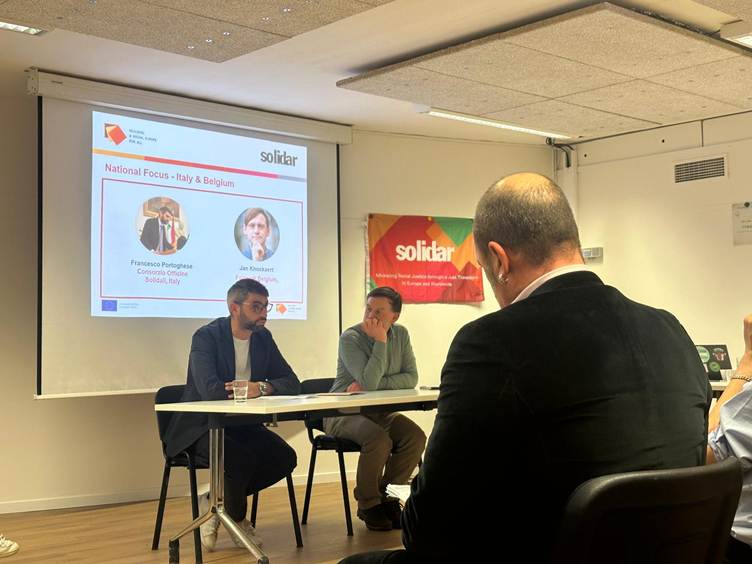
The conference also included a national focus on Italy and Belgium. Francesco Portoghese from Consorzio Officine Solidali reflected on the Italian context and the “Decreto Flussi”, noting that recent policy developments have expanded labour migration quotas primarily to meet labour market demands, without adequate safeguards to prevent exploitation. Jan Knockaert from Fairwork Belgium presented good practices through the case of Noel, an undocumented migrant worker who suffered a serious workplace accident. While Belgium’s firewall between labour and migration authorities enabled Noel to file a complaint without immediate risk of expulsion, his case illustrated severe shortcomings in implementation, as it took fifteen years and sustained civil society support for him to access compensation to which he was legally entitled.
A panel discussion followed with Michelle Levoy, Director of PICUM, and José Antonio Moreno Díaz, lawyer at Comisiones Obreras in Spain and member of the European Economic and Social Committee. The panel examined where migrant workers’ rights sit within labour law, migration law, and health and safety frameworks, and why entire sectors structurally rely on migrant labour under precarious conditions. Speakers emphasised the need to better connect existing EU legislation, research, and evidence from the ground to challenge exploitative practices and counter harmful narratives around migration.
José Antonio stressed that the political debate on migration and labour remains largely absent or distorted, often framed around a misleading labour shortage narrative rather than the lack of quality jobs. He argued for normalising migration as a social reality and embedding migrant workers’ rights more clearly within the European Pillar of Social Rights, while acknowledging the diversity of trade union approaches across Europe. Michelle highlighted the importance of linking different policy areas and improving data collection, particularly on occupational health and safety violations affecting migrant workers.
In his closing remarks, Mikael Leyi returned to the dual nature of the challenge. Migration is deeply political, and current debates are often marked by dehumanising language. At the same time, the EU already has a policy framework, notably the European Pillar of Social Rights, that can be mobilised to address concrete injustices. The urgency, he concluded, lies in acting on both levels simultaneously, challenging harmful narratives while advancing practical solutions through cooperation among like minded actors, to ensure a Social Europe that truly leaves no worker and no community behind.