
The good, the bad and the ugly of Global Gateway projects: a Case study from the Mwache Dam project in Kenya
The Global Gateway Just Transition Scorecard
With Global Gateway-branded projects expanding worldwide, too little is still known about their real impacts on local communities and the people involved. Are they bringing positive contributions for development, the environment and social justice? And how can civil society assess this?
To help answer these questions, SOLIDAR, together with FEPS, FES and the Foundation Jean-Jaurès, has developed the Just Transition Scorecard, a practical tool that enables civil society to assess whether Global Gateway (GG) projects are delivering a just transition in practice. It aims at gathering evidence from local communities and stakeholders on three dimensions – 1) participation and governance, 2) socioeconomic impacts and 3) environmental impacts – helping to identify whether projects benefit local people or leave them to bear the costs of a just transition happening elsewhere.
To pilot the Scorecard, we collaborated with civil society organisations in Kenya to assess the Mwache Dam project, a Global Gateway-backed infrastructure project in the country’s coastal region.
Great ideas, questionable execution
Kenya faces significant water scarcity challenges, and the Counties of Mombasa and Kwale face a water deficit of around 75%. Once complete, the Mwache Multi-Purpose Dam should supply 186,000 m³ a day to over 1.6 million people, a long-awaited good news for local residents. Furthermore, on paper, it has much of what a responsible infrastructure project should have: a detailed resettlement action plan, an environmental and social impact assessment, a plan to protect the marginalised Duruma community, and a grievance redress mechanism.
So why did residents halt construction in 2024? What happened to the promises that persuaded many to accept the dam in the first place? Why people in the affected villages we interviewed told us a different story?
That tension is at the heart of our case study. Working with Kenyan civil society organisations, community leaders and local authorities, our author visited the dam site, the resettlement areas and the creek downstream, and used the Just Transition Scorecard to ask whether the project’s promises had reached the people they were meant for.
What will you find in the full study?
“The communities and civil societies were not involved in designing this project. It is after the project was funded that the community was informed about it. At this point anything that was not good for the community could not be changed. […] The project … has largely left the local community as reactive spectators.”
(Local testimony)
Participation is only one of the issues the study documents. Compensation reached many families late, unevenly, or not at all, and the land plots they moved to often could not support the farming they had relied on, heavily impacting their livelihoods. The local jobs that were promised turned out to be mostly casual and short-term, and the irrigation that many saw as the reason for accepting the dam was scrapped. Downstream, people describe a river that no longer reaches them as it once did, while dust and blasting affect those living close to the site. And when residents raised their concerns, the grievance mechanisms set up for that purpose were seen as lacking independence.
This is not, however, a story of simple failure: new schools, upgraded roads and a health facility have been built as part of the project, and resettled families have moved into better homes with improved sanitation. Local officials who pointed out that Kwale County had been overlooked as a beneficiary of its own dam succeeded in getting the design changed, a reminder of what meaningful consultation can achieve. Understanding why some parts of the project worked while others did not is just as important as documenting where it fell short.
If Europe wants its partnerships to be judged by what they deliver rather than what they promise, Mwache offers a revealing place to start.
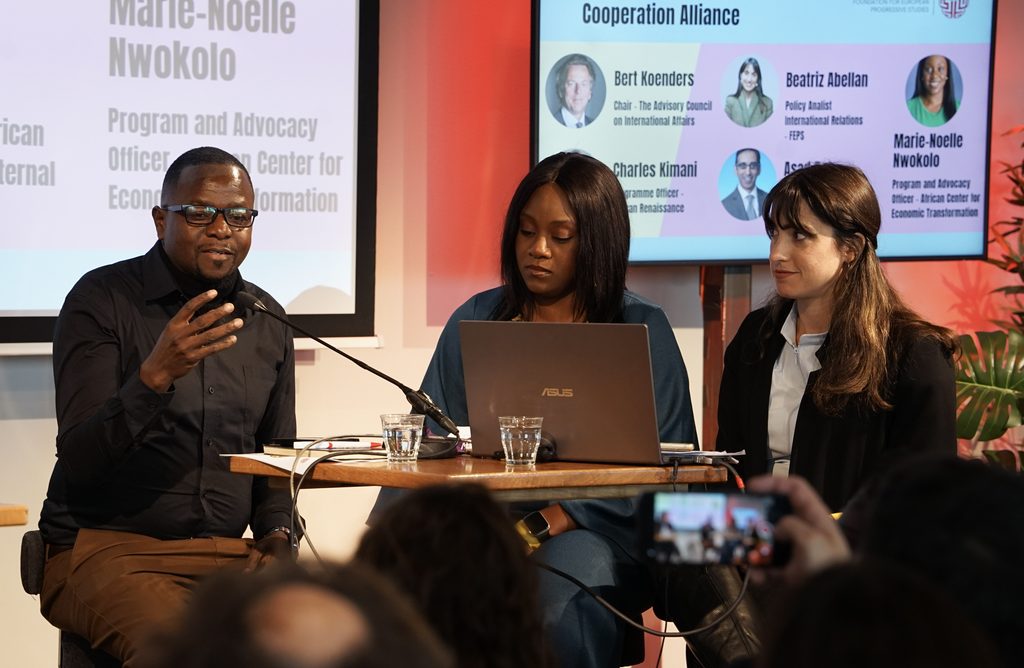
The case study was launched and presented by the author at the Africa Day in Amsterdam during a session dedicated to the future of EU-Africa Cooperation Alliance and helped bringing a concrete testimony on the adequacy of existing cooperation instruments, such as Global Gateway.